
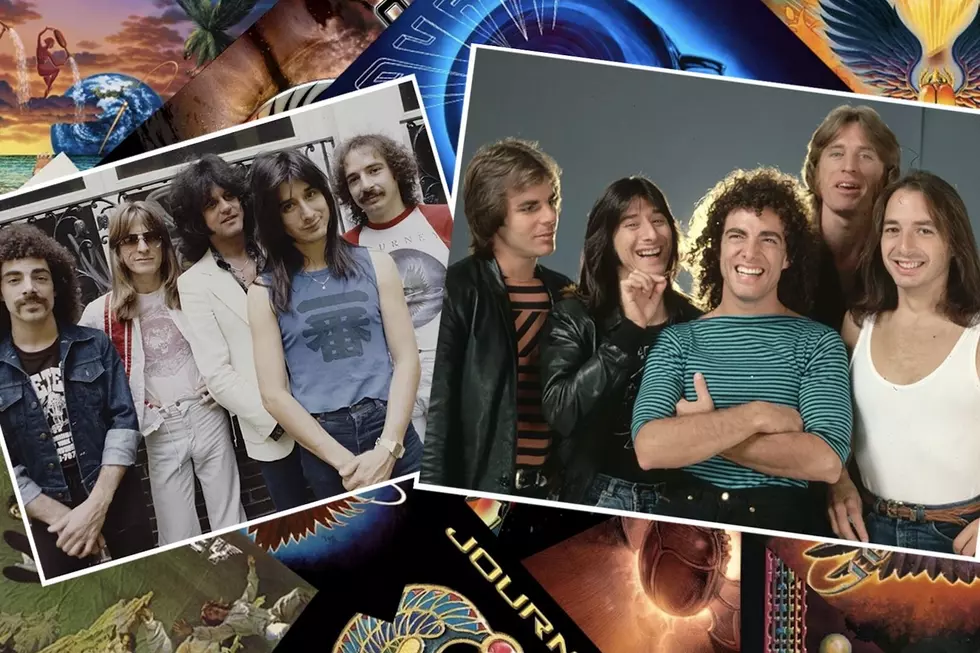
Journey’s Deep Cuts: Counting Down the Top 20
Everyone knows Journey's biggest hits. "Don't Stop Believin,'" their 18-times platinum 1981 smash, has been all but inescapable. And that's just one of the group's half dozen U.S. Top 10 singles.
They could be as varied as they were ubiquitous. Journey certainly became associated with swooning ballads like "Who's Crying Now" and "Open Arms." But they also hit with plenty straight-ahead rockers, including "Separate Ways (Worlds Apart)," "Only the Young" and "Be Good to Yourself."
Even songs that did rise particularly high on the charts became earworms that rock fans couldn't escape. "Lights" failed to break the Top 70. "Wheel in the Sky" only rose about 10 spots higher. "Any Way You Want It" somehow didn't become a Top 20 hit. Neither did "Send Her My Love."
What Were Journey's Best Deep Cuts?
With well over a dozen studio albums, however, singles represent just one chapter in this group's story – even if it's the best-known chapter.
Journey also shared scores of treasured songs that never made their way to a disc jockey's turntable. Big hits may have powered those albums to multi-platinum sales but what kept listeners in front of their speakers were the moments that connected it all together.
Ready for a deeper dive? We're taking a look back at the best of those underrated songs with the following list of Top 20 deep cuts by Journey:
No. 20. "Kohoutek"
From: 'Journey' (1975)
"Kohoutek" works as a bridge between the sounds that Gregg Rolie and Neal Schon made earlier as part of Santana with those to come from their new band, Journey. In fact, the closing instrumental on Side 1 of the group's self-titled debut album emerged during Journey's earliest rehearsals, while a headline-grabbing space rock of the same name was approaching Earth's orbit at an astonishing 200,000 miles an hour.
Long-time San Francisco music writer Joel Selvin called "Kohoutek" a "crushing instrumental tribute to the 'comet of the century,'" after Journey's first-ever concert with Aynsley Dunbar, the drummer who completed Journey's debut-album lineup, in early February 1974. Schon was very much in his element. "Those are my roots, where I came from — blues fusion, and a bit of jazz," he said in Journey: Worlds Apart.
Kohoutek's tail, which was expected to be visible to the naked eye, had been estimated to stretch some 100 million miles. Unfortunately, the comet would be barely seen amid cloudy skies. Journey, which stalled at No. 138, was subject to a similar fate.
No. 19. "Faith in the Heartland"
From: 'Generations' (2005)
They'd already split with Steve Perry when Neal Schon remembered Steve Augeri's early-'90s band Tall Stories. To his ear, they had sounded like Journey — but more up-tempo. Schon tracked down Augeri through a mutual friend. "Coming from a lineage of underachievers, although flattered, I told Joe I thought the idea was crazy and that I was nowhere near in the league of Steve Perry," Augeri said in Journey: Worlds Apart.
"Faith in the Heartland," from their second LP together, argued otherwise. Augeri combined with Jonathan Cain and Schon to complete a boilerplate working-stiff theme that was clearly meant to recall "Don't Stop Believin.'" Yet this song never slips into tribute – or, worse still, parody. Credit goes most of all to Augeri, who strikes a visceral pose on "Faith in the Heartland," singing every line as if his whole heart is in it.
Unfortunately, Generations went nowhere, and Augeri – citing throat problems – was gone after just two albums with Journey. The group then literally erased Perry's first replacement, re-recording the Augeri-sung songs “Faith in the Heartland” and "The Place in Your Heart" with Arnel Pineda for 2008's Revelation.
No. 18. "Anyway"
From: 'Look Into the Future' (1976)
Journey was already at a crossroads after just one album. They were selling plenty of tickets, Schon admitted back then, but not many records. That was not exactly what label execs at Columbia were expecting when Journey rose from the ashes of Santana. Founding manager Herbie Herbert leaped into action, lining up a vocal instructor named Bianca Thornton to sharpen their skills.
Songs like "Anyway," a dark then searching rocker, were better for it. (Not to be confused with "Anyway" from 1994's For the Love of Strange Medicine, which found Steve Perry directly addressing his estrangement from Journey.) This is perhaps Rolie's most desirous vocal performance, but it was also a bit of cheat.
Perfectly titled, Look Into the Future was meant to illustrate how Journey could retain a progressive feel even as they moved toward a new song-focused industry standard. Instead, Journey tried to get there with clever sequencing. Side 1 was home to slightly more radio-friendly fare like "Anyway" (and particularly "On a Saturday Nite") while much longer tracks found a place on Side 2.
No. 17. "Lovin' You Is Easy"
From: 'Evolution' (1979)
Evolution was also aptly named, as Journey set out to refine what worked on their previous album. Legendary producer Roy Thomas Baker leaned more heavily into the honeyed vocal blend created when Steve Perry joined for 1978's Infinity – notably on the singalong No. 16 smash "Lovin', Touchin', Squeezin'." But they were clearly still a band in transition. "Lovin' You Is Easy" makes the point.
The Side 2 opener on Evolution starts as another cookie-cutter '70s-era Journey song, though with a notable new propulsion from Aynsley Dunbar replacement Steve Smith. Then Steve Perry gets to the ear-worm title lyric – and everything changes. "Lovin' You Is Easy" ends up pointing to where Journey was headed.
Well, eventually. Evolution was their highest-debuting LP ever – but only got to No. 50. It had taken eight tries for Journey to finally reach the Top 20 on the singles chart with "Lovin', Touchin', Squeezin'." But then neither "Just the Same Way" (with Gregg Rolie sharing vocals) nor "Too Late" caught a whiff of the Top 40.
No. 16. "We Will Meet Again"
From: 'Arrival' (2001)
Journey was well aware of the mountainous challenges ahead at the turn of the millennium as they entered New York City’s Avatar Studios without Steve Perry. Jonathan Cain openly wondered if going forward was even possible. They could. Journey just needed a new Steve. They began with a belated return to the road with a different singer who sounded enough like Perry to credibly recreate the old songs.
After more than 120 shows in 1998-99, Steve Augeri was finally set to make his first proper studio album with the group. Tracks like "All the Way," which almost broke the Top 20 on Billboard’s adult-contemporary chart, showed that this new edition could uphold Journey’s ballad brand. Then there was "We Will Meet Again," with an inventively layered rhythm from Deen Castronovo that creates a distinct character among Journey's soaring anthems.
It all sets the stage for a moment of controlled fury from Augeri that's unlike anything from an earlier era. "We Will Meet Again" then builds toward a sweeping vista reminiscent of Journey's Roy Thomas Baker-helmed sides like "Winds of March" and "Opened the Door," a welcome development indeed. And as with those two 1978 tracks, "We Will Meet Again" serves as an emotionally resonant side-closing moment.
No. 15. "I Would Find You"
From: 'Next' (1977)
Journey was shifting to shorter tracks and a more varied vocal approach. Too often, however, they still fell into old habits: "Jamming," Neal Schon once admitted, "was the easiest thing we could do." The result was the occasionally unsorted Next, with some radio-friendly moments but also some of their heaviest. ("You know, a lot of metal players connected with that album," Gregg Rolie said in Journey: Worlds Apart.)
"I Would Find You" is the closest Next gets to their subsequent incarnation's tightly wound stadium-filling songs – featuring a rare vocal turn by Schon that's also his most successful with Journey. The only problem? Their records were still bombing. Next reached Journey’s highest chart position to date. As a sign of how poorly things were going, however, the LP only got to No. 85. None of it played like a single.
Schon said Columbia Records finally issued an ultimatum, instructing Journey to add a true front man or risk losing their deal. They’d had enough of the band's incrementalism. Robert Fleishman joined but only long enough to add a few co-writes on their fourth album. But while they were still on tour together in 1977, a guy named Steve Perry entered the picture.
No. 14. "Edge of the Moment"
From: 'Eclipse' (2011)
After a period where Journey risked creative bankruptcy by re-recording old songs, Arnel Pineda finally began to establish his own legacy. On "Edge of the Moment," the big-voiced Pineda ably conveys a fiery sense of sensuality required by the song's narrative while Deen Castronovo and Ross Valory create a foundation-rattling rhythm. But this song will always belong to Neal Schon.
He's by turns melodic, out there, gurgling, eruptive – and nothing like we've heard from him since the days of the spaceman 'fro. Long after their hit single-making days, and a couple of albums into Pineda's tenure, Journey finally found their rock-music mojo again. Credit Schon, who plays with furious third-act abandon.
Eclipse boasted all the musical density and tough propulsion of 1977's Next, with a dash of the approachable pop sensibilities that defined Journey’s later hitmaking era. Unlike the platinum-selling Revelation, however, this album quickly tumbled back down the charts, selling only 100,000 copies. The experiment may not have completely succeeded, but at least they did not resort to photocopying the past again.
No. 13. "Patiently"
From: 'Infinity' (1978)
Robert Fleischman became Journey's first true frontman in 1977, but he only lasted five months beginning in June. Along the way, he unknowingly came face to face with his replacement on July 10, 1977, while backstage at Soldier Field. Perry followed the band out the road and by August had completed "Patiently," his first song with Neal Schon, in a hotel room after a show in Denver.
It was a lightning-bolt moment for Schon, who had been unsure about adding Perry. Ironically, Schon had given Perry a ride home some five years before after sitting in with Azteca in San Francisco, but had no idea his passenger was a singer. Perry finally got the chance to make a first impression with "Patiently," which Schon said was finished in about 45 minutes.
Perry and Schon wrote "Lights" next, and things went even more quickly. "It was really about the determination of me wanting to get next to those players," Perry admitted in veteran San Francisco music writer Joel Selvin's liner notes for the Time3 compilation. Perry was invited to join the band in October.
No. 12. "Here We Are"
From: 'Next' (1977)
Perhaps Journey's heaviest-ever pop song, "Here We Are" was one of the bigger surprises in their early discography – if you didn't know Gregg Rolie's pre-Santana history. He grew up a suburban kid who loved the British Invasion bands of the '60s and eventually developed his own knack for Beatles-esque touches, as hinted at by Journey's cover of George Harrison's "It's All Too Much."
Early on, Rolie was in a Top 40 covers band called William Penn and His Pals, where he actually wore a ruffled shirt. "It was kind of a take-off on Paul Revere and the Raiders," Rolie said in Journey: Worlds Apart. "It was huge in the Bay Area. That was my first introduction to really playing for people in theaters."
Not exactly the makings of a Latin-rock band legend, but Rolie was always much more than that. The ever-quotable Herbie Herbert, who served as a road manager for Santana and then manager of Journey, once described him as "so smart that he’s probably disqualified as a musician."
No. 11. "Somethin' to Hide"
From: 'Infinity' (1978)
Collaborations with Robert Fleischman provided a tailwind for Journey's fourth album, which was completed in a rush of creativity as Steve Perry joined. Fleischman ended up with a trio of co-writing credits while four others sprang from newer collaborations between Perry and Schon, including "Somethin' the Hide."
This marked Journey's first attempt at a power ballad, though they were still years away from perfecting things with "Open Arms." Gregg Rolie was intrigued by the changes. "When Steve Perry entered the band, I welcomed it," Rolie said in Journey: Worlds Apart. "I thought this would be good, and we started writing songs in a different way."
"Somethin' to Hide" was embryonic but still devastatingly effective: Perry's final cry is just astonishing. It was also a signpost for the blues-steeped Rolie's looming offramp. Journey scored the first (but far from their last) multi-million-selling LP, but Rolie only co-wrote three songs on Infinity and he sang lead on just one.

No. 10. "Edge of the Blade"
From: 'Frontiers' (1983)
Frontiers begins with a bang, as Journey unfurls the No. 8 hit "Separate Ways," the No. 12 favorite "Faithfully," and a pair of No. 23 singles in "After the Fall" and "Send Her My Love." Side 2 offers a similarly propulsive start. Buckle up, though. After "Edge of the Blade," fans are in for a rather bumpy ride.
The LP becomes more experimental, less structured. Journey quickly loses momentum. Turns out, there's a reason. Frontiers was ready for pressing, with the track listing already confirmed, when Columbia A&R rep Michael Dilbeck recommended cutting the future hit "Only the Young" as well as "Ask the Lonely." Two other interesting but less commercial songs took their place.
On one level, this provided a welcome opportunity for the band members to stretch their creative muscles. Steve Perry seemed particularly proud of their willingness to break from the winning formula on Escape. Bandmate Steve Smith later framed Side 1 of Frontiers as "for the fans" and Side 2 as "for us." The turning point was "Edge of the Blade."
No. 9. "People and Places"
From: 'Departure' (1980)
"Any Way You Want It" nearly cracked the Billboard Top 20 before Departure completely revealed itself. There was a lot more to the album – and to Journey – than that feel-good single. Fans were clearly looking for more of the same, however, as "Walks Like a Lady" finished at No. 32 before "Good Morning Girl/Stay Awhile" stalled out.
That third single was a better representation of the rangy approach to Journey's third album with Steve Perry, with the first segment of "Good Morning Girl/Stay Awhile" unfolding as an impossibly gorgeous ballad while the second explored his R&B roots. Perry also recorded a rare vocal duet with Neal Schon on "People and Places," employing a circular vocal effect echoes the song's examination of life's maddening duality.
Future Journey drummer and second vocalist Deen Castronovo was listening. He taught himself to play along with these early Perry records. "Steve Perry was my favorite," Castronovo said in Journey: Worlds Apart. "So, for me to even sing a Perry song, I just try to do it justice, man. Steve is a god. To me, he's the greatest rock/R&B singer of my generation — bar none."
No. 8. "Daydream"
From: 'Evolution' (1979)
Journey finally cracked the code with "Lovin,' Touchin,' Squeezin,'" thrusting open the hit-single floodgates for good. They were also making themselves at home in the Billboard album chart's Top 20. But the group's deep cuts remained consistently inventive: "Daydream" is simply a wonder.
The song reimagines Journey as progressive rockers in search of an episodic triumph. "Daydream" is defined by dreamy, Jon Anderson-esque verses, rangy guitar riffs and forward-thinking keyboard asides. It's all very much in keeping with the prog pretensions of the '70s, though that sound was already decidedly out of style.
The irony is, pitched battles took place before this meditiative track was finally completed. Producer Roy Thomas Baker kept sending Neal Schon back to redo his solo. The guitarist once estimated that he tried "50 or 100 times," to no avail. Finally, Schon said he unleashed something straight from the heart – and nailed it.
No. 7. "The Eyes of a Woman"
From: 'Raised on Radio' (1986)
Sessions for Journey's fourth and final album of the decade began with the lineup from Escape and Frontiers intact. But then Steve Perry, fresh off an early solo triumph, took charge. He assumed a producer role for the first time, as Jonathan Cain shifted to a more R&B-stoked compositional style to mimic the vibe of Perry's debut, 1984's Street Talk. Next, Perry decided the band needed a new rhythm section.
He and Cain had changed the early composing process, recording demos on Cain's Mara Machines MCI 24-track recorder with preset rhythm tracks. Now in the studio, Perry pushed for a feel that more closely mimicked them. This was a shock since Journey had always constructed initial song ideas from jam sessions. Perry eventually brought in the main rhythm section from Street Talk.
Ross Valory was absent for the first time ever. Steve Smith only appeared on three tracks, but still made an undeniable impact on "Eyes of a Woman." His anticipatory rhythm builds a palpable tension while an echoing Neal Schon surrounds the vocal. It was like old times. Perry says this is one of his favorite Journey songs, probably because "The Eyes of a Woman" finally resurrected their blockbuster early-'80s sound.
No. 6. "Opened the Door"
From: 'Infinity' (1978)
Infinity spun off a series of seemingly ubiquitous singles, yet "Wheel in the Sky," "Anytime" and "Lights" never reached any higher than the first song's No. 57 finish on the Billboard chart. Instead, the album doggedly made its way to three-times-platinum status on the strength of another relentless round of touring, manager Herbie Herbert's flair with promotion, and sturdy deep cuts like "Opened the Door."
The last song on the first album to feature Steve Perry, "Opened the Door" begins like every gorgeous, ear-wormy love song they ever hit with a few years later — but after Perry's initial three minutes, Gregg Rolie joins in a huge vocal bridge ("Yeah, you opened ..."). Neal Schon is then loosened from those binding conventions to complete a career-turning studio project.
Journey's now-departed original drummer Prairie Prince came away impressed. "Not to take anything from Gregg Rolie, but once they got Steve Perry, it was a whole different world," he said in Journey: Worlds Apart. "They had a formula, and they knew how to rock it — and I was proud of them for that."

No. 5. "When You're Alone (It Ain't Easy)"
From: 'Evolution' (1979)
Roy Thomas Baker came into Journey's orbit with a a set goal: He wanted to match the dynamism of their live shows. By the time the producer returned for Evolution, he had something bigger in mind. Baker said he wanted Journey songs to become "more commercialized," with no "self-indulgent guitar solos" from Neal Schon. (Baker surmised back then that they "bore everyone silly.")
He also wanted "nice, big choruses of vocals" to tie everything together. In this way, Baker set a template for every success that followed. None of Journey's three pre-Perry albums had gotten any higher than No. 85. With Baker, Infinity went all the way to No. 21. They followed that with a three-million-selling smash that spawned their breakthrough hit, "Lovin,' Touchin,' Squeezin.'"
Nothing would ever be the same for the band – not even their deep cuts. As with Journey's big single, "When You're Alone (It Ain't Easy)" was "more commercialized" with "nice, big choruses of vocals." Perry chirps and coos his way through this winking tease of a song until about a third of the way through, when Schon provides a quick moment of release ... but, no, not enough to "bore everyone silly."
No. 4. "Forever in Blue"
From: 'Trial by Fire' (1996)
Whatever critics thought of the music, Trial by Fire proved one thing: Even in the post-grunge era, there was still an audience for Journey. A decade after their last album, this reunion project became their fourth-consecutive Top 5 hit, selling a million copies in the United States alone. Even on deep cuts like "Forever in Blue," Journey put it all together again – sounding nothing so much like themselves.
After so long together making music, fans could be forgiven for assuming everything unfolded with familiar ease. It most assuredly did not. In fact, new producer Kevin Shirley put the newly reformed early-'80s lineup through a meticulous woodshedding regimen. By the time they headed into the studio, Journey was at cruising altitude.
"The real challenge was, I don't think any of us were used to rehearsing as much as we did," Neal Schon said in Journey: Worlds Apart. “But it turned out to be a good thing. We rehearsed for a good six weeks. That's a long time. We basically rehearsed everything like we were going to play a brand-new record live, with no overdubs." They basically did, and "Forever in Blue" was better for it.
No. 3. "Of a Lifetime"
From: 'Journey' (1975)
Journey's recorded output begins here, with a seven-minute jazz fusion-influenced, at times Pink Floyd-ish excursion that boldly stepped away from Gregg Rolie and Neal Schon's previous work in Santana. They arrived with a pedigree from Santana and a legacy of rangy musical heroics but, as Rolie rightly noted, there would be no conga drums.
So why did the label pair the new band with Roy Halee, a pipe-smoking, overly meticulous idiosyncratic who was best known for work with Simon and Garfunkel? "Halee was just nuts," longtime San Francisco music critic Joel Selvin said in Journey: Worlds Apart. "He was a really fussbudget old-time engineer, and these guys were raring-to-go young guys that could have ripped a new one in any tape he put up on the console."
Though clearly a mismatch, Halee made a smart choice by asking Schon to double his first-take solo. Schon nailed the repeat performance and "Of a Lifetime" was complete. Its more wide-open early approach might have found a wider audience, Gregg Rolie told me, in the throwback jam-band era still to come: "It's almost like, 'What, are we ahead of our time?' You know, in a way — yeah. It just didn't catch at that time."
No. 2. "Someday Soon"
From: 'Departure' (1980)
This was the final major vocal collaboration featuring Steve Perry and Rolie and one of the most memorable for its thoughtful optimism. It's easy to imagine now that Rolie was already looking ahead as he prepared for his own departure. "I didn't want to quit singing, but it got diminished – there's no doubt," Rolie said in Journey: Worlds Apart. "I don't think Perry really liked me singing."
Still, the upbeat outlook surrounding "Someday Soon" was warranted – even if that belied its difficult birth. Departure became their highest-charting LP to date. A wildly successful tour was then chronicled on 1981's Captured. "The thing is, that song was so difficult to write," Rolie said. "I ended up looking out the window, and the lyrics just wouldn't come. Finally, that's what popped into my head — someday soon."
Largely overlooked at the time, "Someday Soon" eventually got its due when this deep cut became part of a university curriculum. "I said, 'Really?! Maybe I will finally get a degree of some sort,'" Rolie added, laughing.
No. 1. "Do You Recall"
From: 'Evolution' (1979)
Journey was about to claim their second consecutive multi-platinum certification in album sales. But to a large degree, they had been pushed to this plateau. Neal Schon and Gregg Rolie didn't necessarily want to go pop, but founding manager Herbie Herbert had the ambition and Steve Perry had the voice. Then there were also larger trends at play, as disco faded. What would fill the void? Turns out, it was Journey.
As with much of Evolution, "Do You Recall" tended to straddle Journey's two eras – but no deep cut did it more effortlessly. This is the perfect blending of their tough early sound and Steve Perry's sun-flecked sense of reminiscence. Then long-time Queen producer Roy Thomas Baker's familiar stacked vocals propel the bridge to untold heights. The '80s were just over the horizon.
Journey was building toward their superstar future with a tighter focus on Perry, but not just on singalong radio favorites like this album's signature single "Lovin,' Touchin,' Squeezin.'" Arrangements and solos that were once wildly expansive came into more radio-ready focus on this album. Under Baker's watchful eye, Perry's ardent, broadly approachable composing style on songs like "Do You Recall" completed the puzzle.
Ranking Every Journey Live Album
Gallery Credit: Nick DeRiso
See Neal Schon Among Rock’s Forgotten Supergroups
